
By Brett Francis
Still Standing
There's something particularly frustrating about being someone who speaks publicly about resilience, mental health, self-compassion, and respecting your limitations, only to find yourself struggling to follow your own damn advice.
Apparently, life decided it was time to test me on everything I've been preaching.
And quite frankly, I haven't been passing with flying colours.
When Your Body Makes the Decisions for You
After returning from travelling, I knew I would need some time to recover. What I underestimated was just how much recovery my body and mind would demand.
Between chronic pain, poor sleep, physical exhaustion, anxiety, and mental burnout, I found myself running on empty.
Having undergone four major spine surgeries, I'm no stranger to recovery. But knowing what recovery requires and emotionally accepting it are two entirely different things.
Even when I was physically resting, my brain was running through an endless inventory of everything I wasn't accomplishing.
There were responsibilities to manage, things I wanted to accomplish, and podcast episodes I hadn't recorded.
I felt guilty for resting, frustrated by my limitations, and disappointed in myself for not being able to do more.
It's exhausting being exhausted—and then mentally exhausting yourself further because you're exhausted.
Knowing Better Doesn't Make It Easier
One of the biggest misconceptions about self-awareness is that once you understand your patterns, you should automatically be able to change them.
Wouldn't that be fucking convenient?
I know that pushing myself beyond my capacity has consequences. I know that recovery isn't linear. I know that productivity doesn't determine my worth.
I've spoken about these very things.
Yet here I am, still struggling to separate what I accomplish from how I feel about myself.
Self-awareness is a tool. It isn't a cure.
Understanding why I feel guilty doesn't automatically eliminate the guilt. Recognizing unhealthy expectations doesn't mean I've stopped placing them on myself.
Personal growth doesn't mean we never struggle with the same things again. Sometimes it means recognizing those struggles sooner and gradually learning to respond differently.
When Something You Love Becomes Another Obligation
Still Standing is something I'm incredibly passionate about.
I created this podcast because I wanted to have honest conversations about the things people often struggle with privately. I wanted to create a space where vulnerability wasn't something to be embarrassed about.
But during my recovery, the podcast became another thing on my mental list of everything I wasn't accomplishing.
Instead of celebrating what I had already created, I was disappointed about what I hadn't produced.
Something that brought me purpose was becoming another measuring stick for my productivity.
And that's not what I ever wanted it to become.
I don't want to sacrifice my well-being to create content about protecting your well-being. The irony of that isn't lost on me.
A Reminder of Why I Started
During this period, I received some unexpected feedback about Still Standing.
I learned that people had been listening to my episodes, finding comfort in these conversations, and sharing them with others who might need to hear them.
People were feeling seen, understood, validated, and hopeful.
I can't adequately explain how much that meant to me.
Not because of recognition, numbers, or any desire to pat myself on the back. But because knowing that something I've created is genuinely making a difference is exactly what I hoped for when I started this podcast.
And then something struck me.
Those episodes weren't newly recorded.
They were already out there.
Still being listened to.
Still being shared.
Still making a difference.
Even while I was resting.
I'd become so focused on everything I hadn't accomplished recently that I'd almost forgotten to appreciate what I'd already put into the world.
My impact hadn't disappeared simply because I needed a break.
And neither does yours.
The Invisible Work of Recovery
Recovery doesn't always look productive from the outside.
Sometimes it looks like cancelling plans, attending physiotherapy, going to counselling, accepting help from your partner, managing medications, or spending an afternoon doing absolutely nothing.
Sometimes it's making the difficult decision not to do something you desperately want to do because you know what it might cost you tomorrow.
I've been learning to ask myself a different question.
Instead of asking, “How much can I get done today?” I'm trying to ask:
“What can I realistically do today without making tomorrow harder?”
It's a small shift in wording, but a significant shift in mentality.
It requires me to consider my future well-being rather than just my immediate desire to accomplish something.
And some days, I still hate the answer.
I'm grateful for the support I have, particularly from Riley, and for the people who understand that my capacity can change from one day to the next.
But accepting support and adjusting expectations is still something I'm actively learning.
Resilience Doesn't Always Mean Pushing Through
We tend to celebrate resilience when it looks impressive.
When someone overcomes an obstacle, achieves something extraordinary, or continues moving forward despite overwhelming circumstances.
But what about the quieter forms of resilience?
Recognizing when you've reached your limit. Admitting that you're struggling. Asking for help. Choosing not to push yourself into another setback.
Those decisions rarely receive the same recognition, yet they can require an incredible amount of strength.
I'm learning that resilience isn't measured by how long I can push myself before I collapse.
Sometimes, resilience means sitting your ass down.
You Don't Need a Perfect Ending
I wish I could finish this article by telling you I've figured everything out.
That I've completely overcome the guilt, accepted my limitations, found the perfect balance, and returned to feeling like myself.
But that wouldn't be true.
I'm still somewhere in the messy middle.
I'm still learning to live within a capacity that doesn't always match my ambitions. I'm still navigating the frustration of wanting to do more than my body allows. I'm still working on giving myself the same compassion I so readily extend to other people.
And I think there's value in sharing that part of the story, too.
We don't have to wait until we've overcome something before talking about it. There's something meaningful about being honest while we're still experiencing it.
Not every story needs a perfectly packaged lesson or a triumphant ending.
Sometimes, the story is simply that we're still here, still trying, and learning as we go.
Your Still Standing Challenge
This week, I want you to ask yourself three questions:
Am I expecting myself to function at a capacity I don't currently have?
Am I confusing necessary rest with falling behind or failing?
What is one expectation I can remove from myself this week?
You don't need to completely change your relationship with productivity overnight.
But perhaps you can start by recognizing that everything you've contributed, everything you've accomplished, and every difference you've made doesn't suddenly become meaningless because you need time to recover.
I don't have to sacrifice my recovery to prove that my work matters.
And you don't have to exhaust yourself to prove that you matter, either.
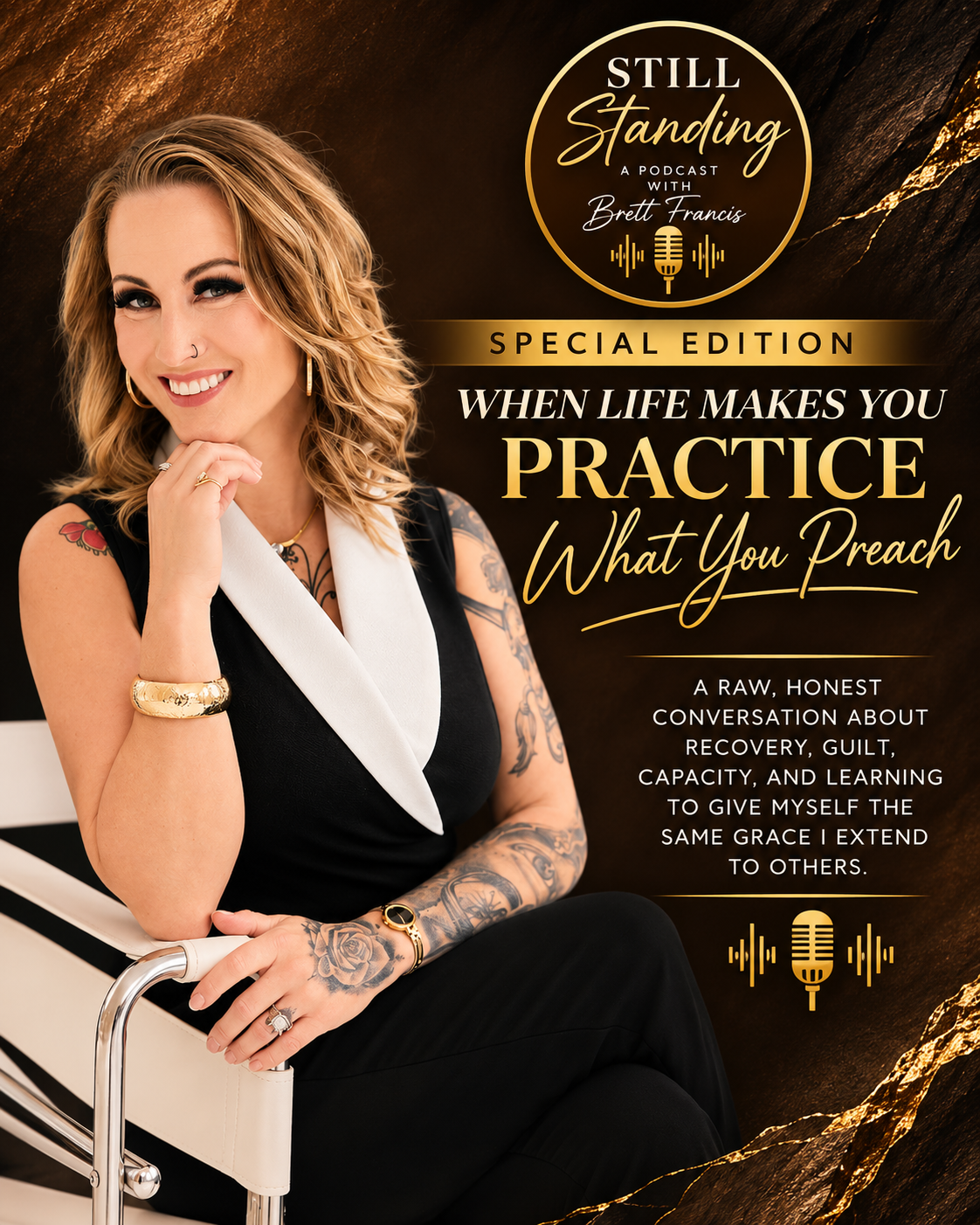
Listen to the Still Standing Special Edition
When Life Makes You Practice What You Preach
Join me for an honest conversation about chronic pain, burnout, recovery, guilt, and learning to give ourselves the same compassion we offer others.
🎧 Listen to Still Standing with Brett Francis
Real stories. Real struggles. Real strength.
Still healing.
Still hurting.
Still learning.
Still standing.