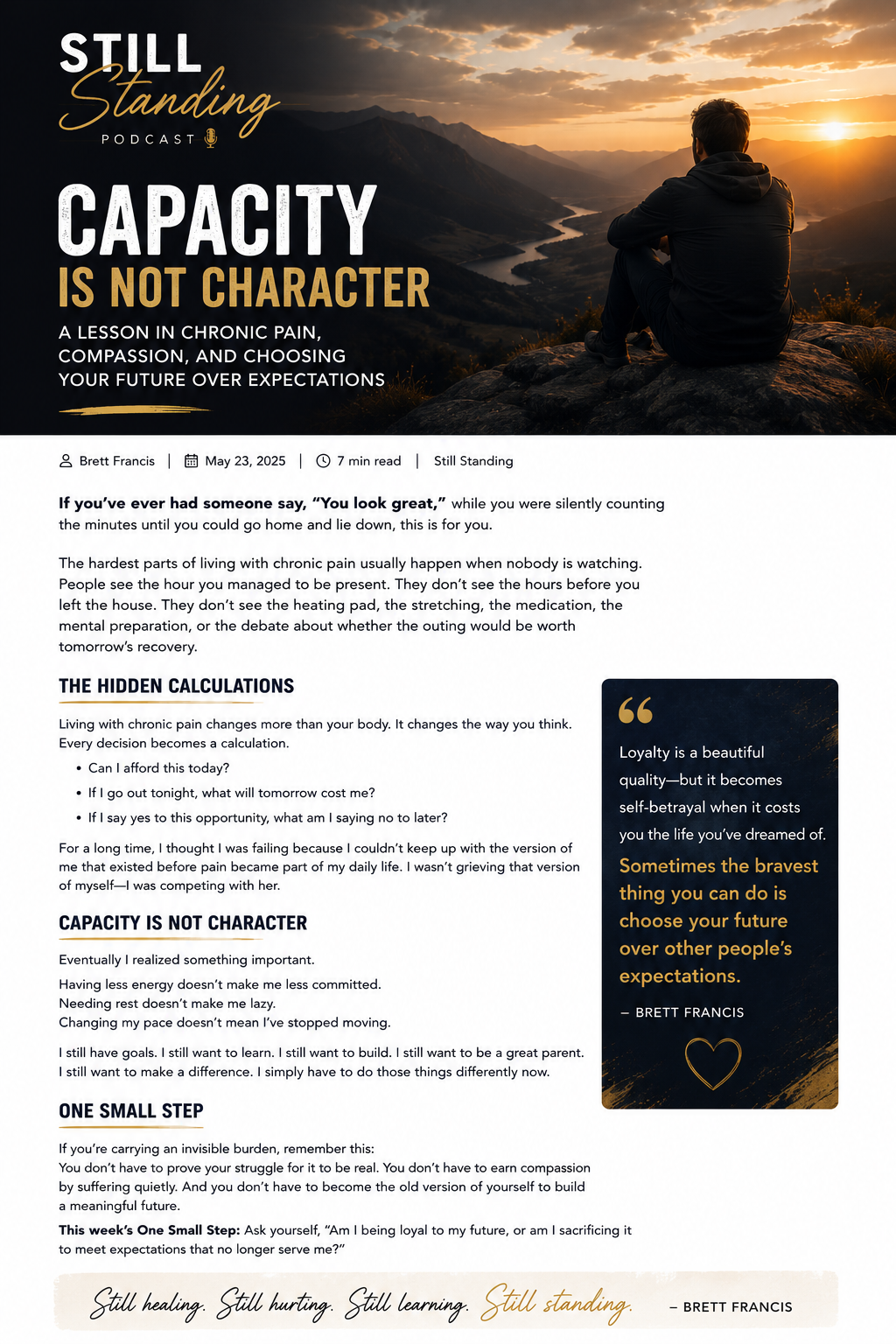
By Brett Francis
Still Standing
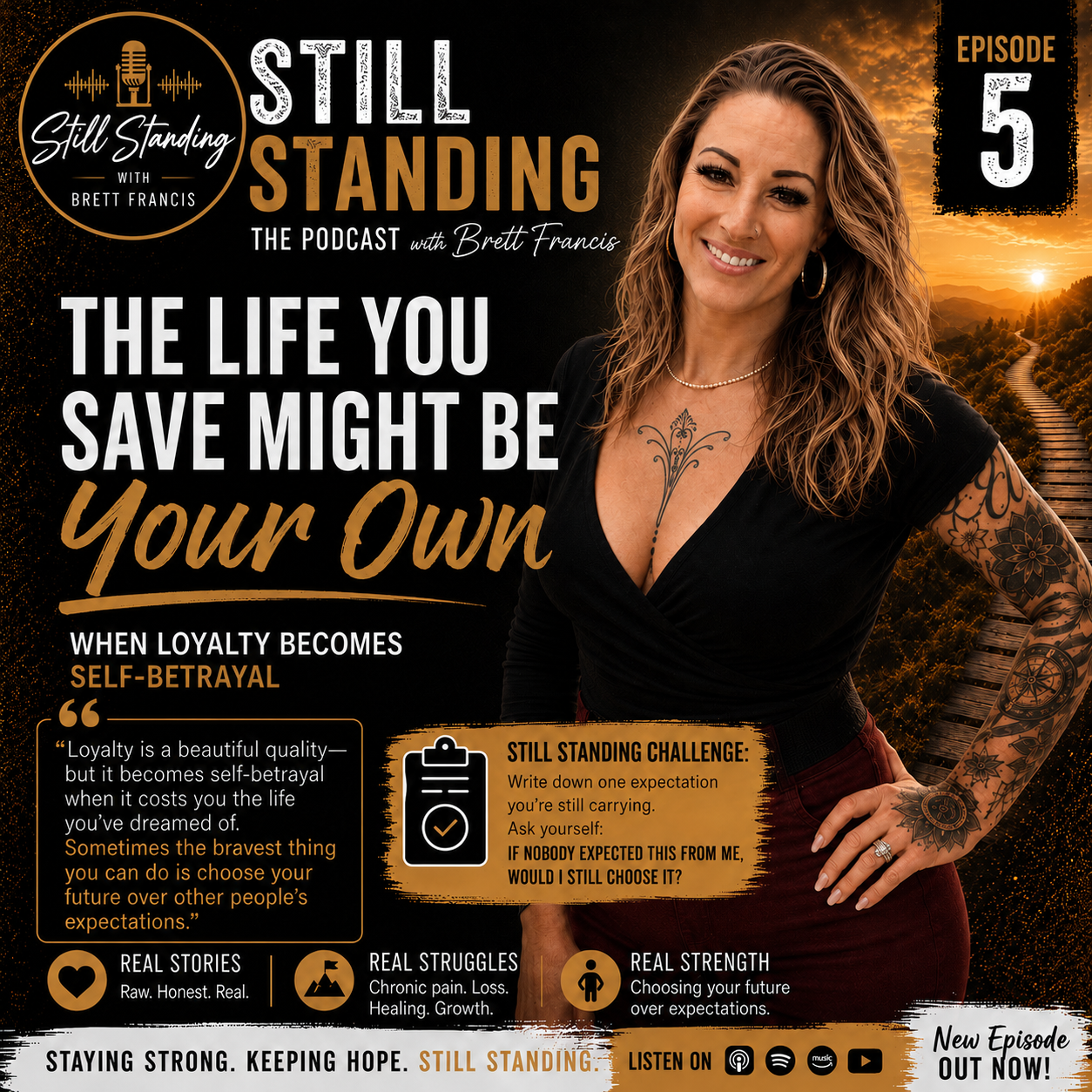
Loyalty is one of the qualities we admire most.
We're taught from a young age to be loyal—to our families, our friends, our relationships, our careers, and the commitments we make. Loyalty is often seen as a measure of character, and in many ways, it is.
But over the past few years, I've learned something I never expected.
Loyalty can become dangerous when it doesn't include yourself.
For a long time, I believed that being a good person meant always showing up, pushing through, and never letting people down. I wore "being dependable" like a badge of honour. If someone needed me, I would find a way. If something had to get done, I would push through the pain. Rest felt like failure, and asking for help felt like weakness.
Then my body forced me to stop.
When Life Doesn't Go Back to Normal
After my fourth major spine surgery, I kept waiting for my old life to return.
I told myself that if I worked hard enough, stayed positive enough, and pushed through the pain long enough, eventually I'd become the person I used to be.
But every time I ignored my limits, my body reminded me there was a price.
I wasn't borrowing energy.
I was borrowing health.
And the interest was pain, exhaustion, and longer recoveries.
One of the hardest parts wasn't the physical pain.
It was grieving the life I thought I was going to have.
We often think of grief as something that happens when we lose another person. But grief can also come from losing a version of yourself.
The person who could work all day.
The person who never cancelled plans.
The person who didn't have to calculate every decision based on how much energy they had left.
For a long time, I wasn't grieving that version of myself.
I was competing with her.
The Weight of Expectations
I remember sitting in my car after medical appointments, crying before driving home.
Not because the appointment had gone badly.
But because every appointment reminded me that life had changed.
I cancelled dinners with friends.
I cancelled plans I had been excited about.
I cancelled things that mattered to me.
Every cancellation came with guilt.
I worried people thought I was lazy.
I worried they thought I wasn't trying.
So I kept pushing.
I kept saying yes.
I kept trying to prove that I was still the same person.
Looking back, I realize I wasn't trying to convince other people.
I was trying to convince myself.
The Conversation That Changed Everything
It wasn't one life-changing moment.
It was a series of conversations with my family and my counsellor.
People who loved me enough to tell me something I didn't want to hear.
"Brett, you have to stop trying to earn your old life back."
At first, those words felt like giving up.
But over time, I realized there is a huge difference between giving up and accepting reality.
Acceptance isn't surrender.
Acceptance is honesty.
It means acknowledging where you are today so you can build a future instead of fighting the past.
That shift changed everything.
Becoming a Parent Changed My Perspective
One of the biggest turning points came when I looked at everything through the lens of being a parent.
I realized that if I continued living as though nothing had changed, I wasn't just risking another surgery.
I was risking the future I wanted with my daughter.
I want to be present for her.
I want to make memories with her.
I want to watch her grow up.
Protecting my health stopped feeling selfish.
It became one of the most loving things I could do.
Choosing rest wasn't quitting.
It was investing in tomorrow.
Loyalty Should Never Cost You Yourself
As I reflected on my life, I noticed this pattern wasn't limited to chronic pain.
I had stayed in unhealthy relationships longer than I should have because I thought loyalty meant never walking away.
I kept people in my life who drained me because I thought saying no made me a bad person.
I chased expectations that no longer fit my reality because I was afraid people would think I had given up.
The one person I consistently failed to be loyal to was myself.
Today, I see loyalty differently.
Real loyalty isn't about sacrificing yourself until there's nothing left.
It's about staying true to your values while also protecting your well-being.
You cannot pour from an empty cup.
You cannot continue giving if you never allow yourself to recover.
The people who truly love you don't want your sacrifice.
They want you.
Redefining Strength
For years, I believed strength looked like pushing harder.
Now I believe strength often looks quieter.
Strength is saying:
"I can't today."
"I need help."
"I need to rest."
"I'm choosing my future over proving myself in the present."
Those words don't come naturally to me.
If you're someone who's always been the dependable one, they probably don't come naturally to you either.
But learning to say them might be one of the strongest things you'll ever do.
Your One Small Step
Every episode of Still Standing ends with one simple challenge.
This week's challenge is this:
Take five minutes.
Write down one expectation you're carrying.
Then ask yourself:
If nobody expected this from me, would I still choose it?
If the answer is no, maybe it's time to let that expectation go.
Not because you've failed.
But because your life has changed.
And there's courage in choosing a future that works with your reality instead of constantly fighting against it.
Final Thoughts
If there's one thing I hope you take away from this, it's this:
Your worth is not measured by how much you sacrifice.
Protecting your health doesn't make you selfish.
Changing your pace doesn't make you weak.
And choosing yourself doesn't mean you're abandoning others.
Sometimes, the bravest act of loyalty is finally extending that loyalty to yourself.
Because the life you save...
might be your own.
Enjoyed this article?
If this resonated with you, I'd love for you to listen to the latest episode of Still Standing, follow the podcast, and share it with someone who might need the reminder that they don't have to sacrifice themselves to prove their worth.
Until next time...
Still healing. Still learning. Still standing.